
Connect Every Tool into One Reliable Data Flow
You don't always need to rip and replace every tool—sometimes your biggest bottleneck is that your systems refuse to talk to each other. We build rock-solid API bridges, webhook pipelines, and unified data layers that keep your CRM, accounting software, payment processor, inventory, and field tools continuously synchronized without manual CSV exports.
Why off-the-shelf tools fail at Systems Integration
- [✓]Companies re-keying invoices between operations software and QuickBooks/Xero
- [✓]Businesses with mismatched customer or inventory counts across platforms
- [✓]Teams needing a unified executive dashboard across multiple data sources
- [✓]Organizations modernizing legacy databases without disrupting daily work
Double & Triple Data Entry Across Departments
Sales enters the customer in one tool, ops creates the job in another, and accounting re-types the invoice in QuickBooks.
No shared customer/job identifier or automated two-way sync between departmental tools.
Conflicting Numbers & 'Which Report Is Right?'
The CRM says one revenue number, Stripe says another, and accounting reconciliations take days at month-end.
Point-to-point scripts lack idempotency, reconciliation logs, and a single source of truth.
Vendor APIs With Rate Limits & Missing Features
Off-the-shelf connectors sync only 3 basic fields and fail whenever custom fields, line items, or refunds are involved.
Generic connectors aren't built for your custom fields, tax rules, or multi-entity accounting structure.
From fragmented busywork to one unified flow
- 01Bookkeeper manually copies completed jobs into QuickBooks every week
- 02Failed payments or refunds in Stripe aren't reflected in the operational portal
- 03Inventory or calendar availability drifts out of sync across channels
- 04No audit log when a sync fails—issues are only discovered when a customer complains
- 01Two-way webhook and API sync creates customers, invoices, and payments automatically
- 02Idempotent event queues guarantee every transaction is processed exactly once
- 03Central data warehouse and sync health monitor with instant Slack/email alerts
- 04Every tool in your business reflects the exact same customer and job state in real time
Production deliverables you own 100%
Custom Two-Way API & Webhook Bridges
Direct integrations with QuickBooks, Stripe, Twilio, HubSpot, Google Workspace, ERP systems, and industry APIs.
Idempotent Sync Queues & Dead-Letter Recovery
Guaranteed delivery with automatic backoff retries, deduplication keys, and one-click replay if a third-party API goes down.
Unified Cross-System Reporting Database
Mirror data from all your tools into a clean relational schema for instant cross-company KPIs and margin reporting.
Sync Health Dashboard & Exception Alerts
Complete visibility into every synced payload, latency metric, and validation warning so nothing ever drops silently.
Systems shipped with this capability
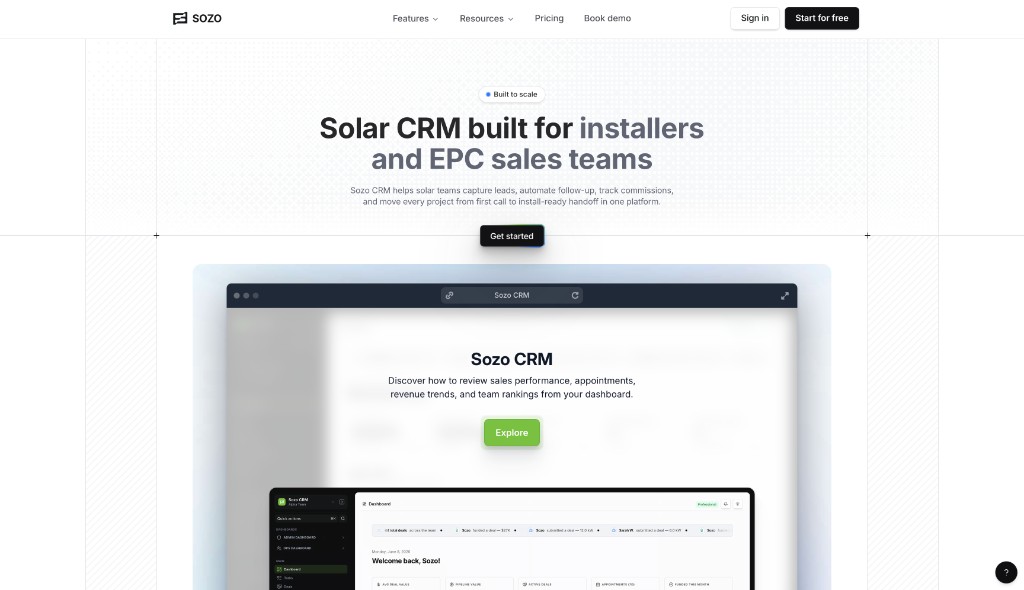
Sozo CRM
A bespoke CRM and operational command center built for solar and field sales organizations—replacing disconnected lead sheets, rep trackers, and install handoff spreadsheets.

Elevate Solar
A conversion-engineered web platform and lead qualification pipeline that educates homeowners, captures utility usage profiles, and routes qualified solar consultations directly into operations.

HR Heating & Cooling
A modern service booking and dispatch web application for HR Heating & Cooling that turns emergency AC/heating searches into triaged, scheduled service calls without phone tag.
Questions about Systems Integration
What happens if an external API like QuickBooks or Stripe goes down temporarily?
Our integration pipelines queue every event durably with idempotency keys. If an external provider experiences an outage or rate limit, the queue automatically retries with exponential backoff and processes the backlog without losing or duplicating a single record.
Can you integrate with older or industry-specific software?
Yes. Whether your existing tool has a modern REST/GraphQL API, SOAP endpoints, webhook support, direct database access, or scheduled SFTP/CSV exports, we can build a clean bridge around it.
Can we start by integrating our current tools and replace them gradually later?
That is one of the smartest paths. By putting a unified database and integration layer in the middle first, you stop the manual double-entry immediately and can phase out expensive legacy tools one module at a time without disrupting operations.
Ready to build your systems integration platform?
Available for businesses across Shreveport, LA, Benton, LA, Marble Falls, TX, Austin, TX, Hughes Springs, TX, Longview, TX, Commerce, TX, Kansas City, MO, and remote nationwide.